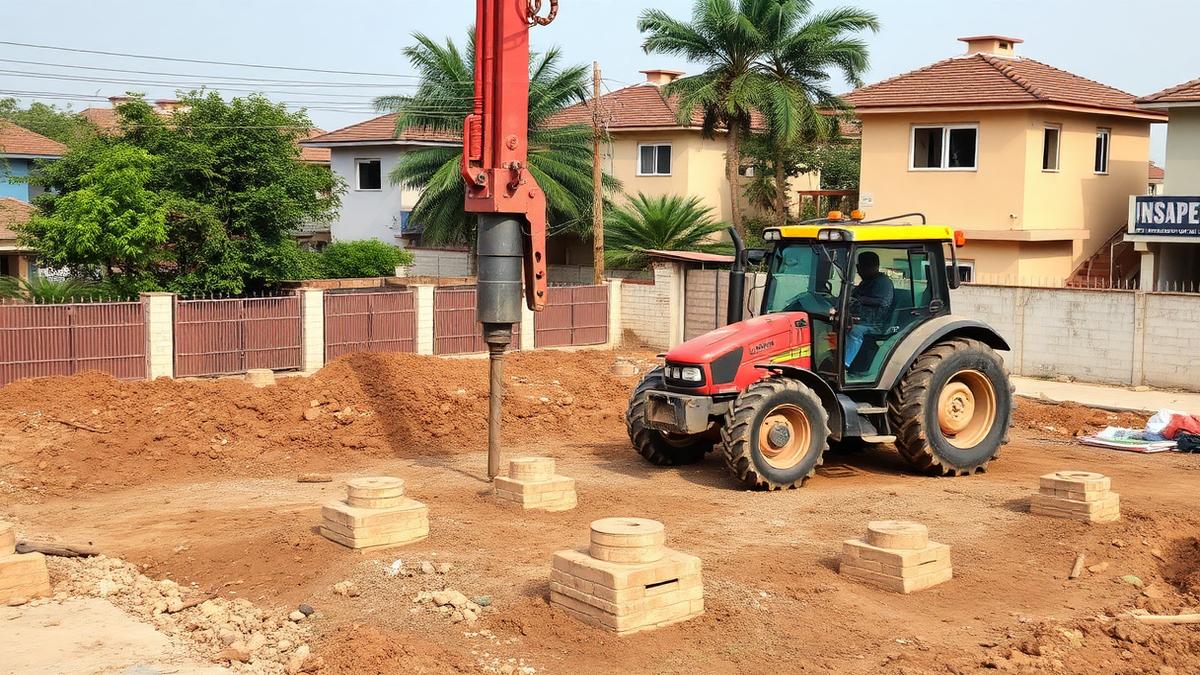
The southern suburbs — Tambaram, Chromepet, Perungalathur, Guduvanchery, Urapakkam, Maraimalai Nagar and Chengalpattu — are where most of Chennai's new independent houses, small apartment blocks and industrial sheds are being built. The plots are affordable, the highway and suburban rail access is good, and the ground varies enough from street to street that generic foundation advice is genuinely dangerous.
The soil picture south of the city
Two distinct problems show up repeatedly in this belt:
Expansive clay. Large pockets around Tambaram, Guduvanchery and Maraimalai Nagar contain clay with high swell-shrink potential. It expands during the monsoon and contracts in summer, and a shallow footing riding on it will crack the walls above within a few seasons. This is the classic case for under-reamed piling — the bulb below the active zone anchors the structure against both settlement and uplift.
Filled tank beds and low-lying land. Many newer layouts were formed on filled ground beside old irrigation tanks. The fill is uncontrolled and compressible, so load must be carried through it to firmer strata below, typically with bored cast in-situ piles.
Further towards Chengalpattu, stiff clay and weathered rock appear at moderate depth, and rotary hydraulic piling becomes the efficient choice where a rig has to socket into rock.
Matching method to project type
- Independent houses (G+1, G+2): under-reamed piles, usually 300–450 mm with one or two bulbs, installed by tractor-mounted rig. Fast, economical and ideal for narrow plots.
- Small apartment blocks (G+3 and above): bored cast in-situ piles, 450–600 mm, terminated in firm strata after soil investigation.
- Factory sheds and warehouses: bored or driven cast in-situ piles designed for column and crane loads, plus separate treatment for floor slab subgrade.
- Compound walls on expansive soil: short under-reamed piles — a small cost that prevents the most common complaint in this belt.
Why soil investigation is not optional here
Because the ground changes so sharply across short distances, borrowing a neighbour's soil report is a false economy. We routinely see two plots on the same street where one needs six-metre under-reamed piles and the other needs twelve-metre bored piles. A standard investigation — two or three boreholes with SPT to the required depth, plus lab classification — costs far less than the over-design or remedial work that guessing produces.
Access advantages in the suburbs
Unlike central Chennai, most southern-suburb sites have open access and space to stack materials, which reduces mobilisation cost and lets us finish faster. For plots inside tight residential layouts, our tractor-mounted rigs work in access widths where larger equipment cannot enter, and produce far less disturbance to neighbouring houses.
Testing, records and handover
Every job includes pile load testing to IS 2911 — an initial test where required by the design, and routine tests on working piles. You receive a pile log covering depth, strata at termination, concrete quantity, reinforcement and the date of casting, along with the load test curves. That record is what your structural engineer signs off against and what a bank or buyer may later ask to see.
Building in the southern suburbs?
Sri Saai Pile Foundation serves Tambaram, Chromepet, Perungalathur, Guduvanchery, Urapakkam, Maraimalai Nagar and Chengalpattu with our own rigs and crew. Call +91 94449 71367 for a free site inspection, or send your plan and soil report to saaipile@gmail.com for an itemised quotation.