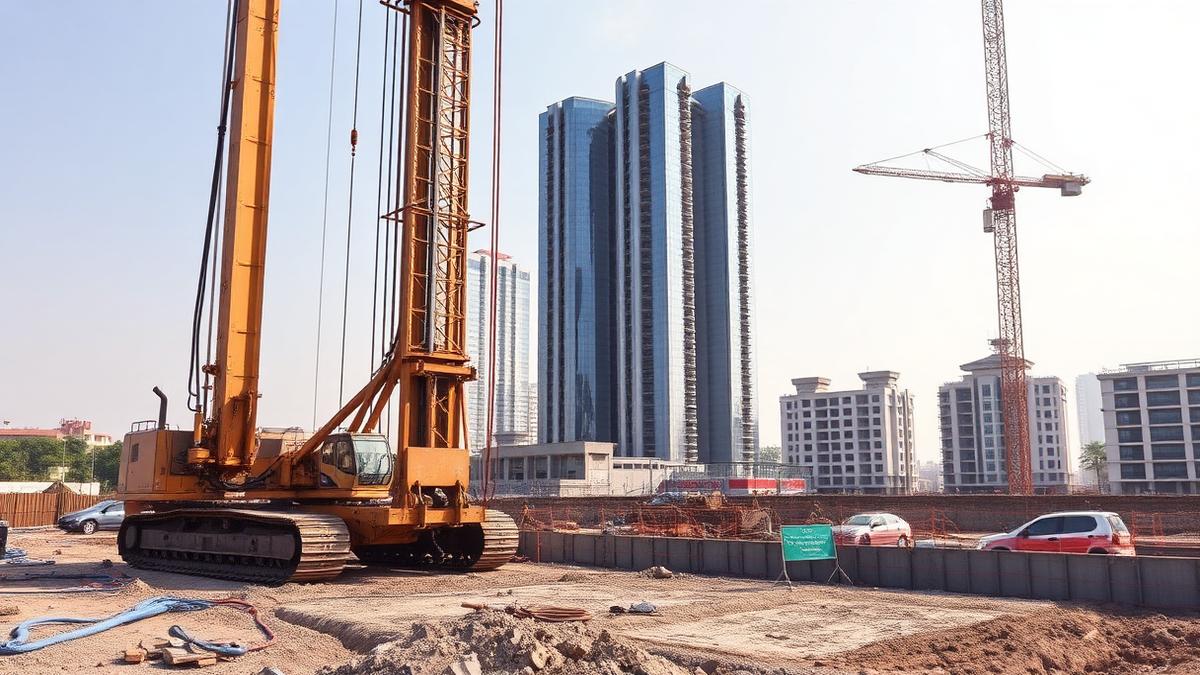
Old Mahabalipuram Road carries more new construction per kilometre than almost any other stretch in Tamil Nadu. IT campuses, gated apartment blocks, hotels, hospitals and warehousing keep pushing outward from Perungudi towards Siruseri, Kelambakkam and Padur. What most owners discover only after the first borehole is that the ground under this corridor is far less uniform than the skyline suggests.
The OMR ground story
Long stretches of the corridor were laid over former marshland, tank beds and low-lying agricultural land that was filled to road level. A typical OMR borelog reads something like this: two to four metres of uncontrolled fill, followed by soft to medium marine clay, then medium-dense to dense sand from roughly twelve metres, with the water table sitting within two metres of ground level for most of the year.
Three practical consequences follow from that profile:
- Shallow footings are rarely viable for anything above two floors, because the fill and clay layers settle unevenly under load.
- Dewatering is part of the job, not an afterthought. Bore stability depends on managing the water table with casing or bentonite slurry.
- Pile length varies across a single plot. Two boreholes on a one-acre site can differ by three or four metres in the depth at which competent sand is met.
Which piling method suits OMR sites
For the majority of OMR projects we execute bored cast in-situ piling, socketed into the dense sand layer below the clay. It is the low-vibration option, which matters because most OMR plots are hemmed in by occupied offices, apartments and live traffic. Where column loads are heavy — commercial towers, multi-level basements — rotary hydraulic piling allows larger diameters (750 mm to 1000 mm) with faster, straighter boring.
Driven cast in-situ piling still has a place on open, undeveloped parcels further down the corridor, where vibration is not a nuisance issue and the speed advantage is real.
Working inside a live corridor
Executing piling on OMR is as much a logistics problem as an engineering one. Rig mobilisation has to be timed around traffic restrictions, slurry and spoil removal has to be scheduled so it does not spill onto the service road, and rig movement inside the plot has to be sequenced so that concrete pours are never blocked. We plan all three before the rig leaves the yard, and we keep a site engineer on the ground for the full duration rather than rotating supervision.
Testing and documentation
Every OMR project we complete includes pile load testing to IS 2911 — an initial test where the design is new or the load is unusually heavy, and routine tests on a percentage of working piles. Integrity testing is worth specifying on clay-heavy sites where necking is a genuine risk during concreting. You receive a pile-by-pile log with bore depth, termination strata, concrete volume and reinforcement details, which is exactly what your structural consultant and any future lender or auditor will ask for.
What it costs and what drives the cost
Piling rates on OMR are driven by pile diameter, termination depth, the number of piles, casing requirements and access. The single largest variable is depth — and depth is decided by the soil report, not by negotiation. A proper geotechnical investigation, which costs a fraction of the piling package, routinely saves more than it costs by preventing over-designed pile lengths across a hundred-pile job.
Planning a foundation on OMR?
Sri Saai Pile Foundation has executed deep foundation works across Perungudi, Thoraipakkam, Sholinganallur, Navalur, Siruseri, Kelambakkam and Padur for more than 25 years, with our own rigs and our own crew. Call +91 94449 71367 for a free site inspection, or email your drawings and soil report to saaipile@gmail.com for an itemised quotation.