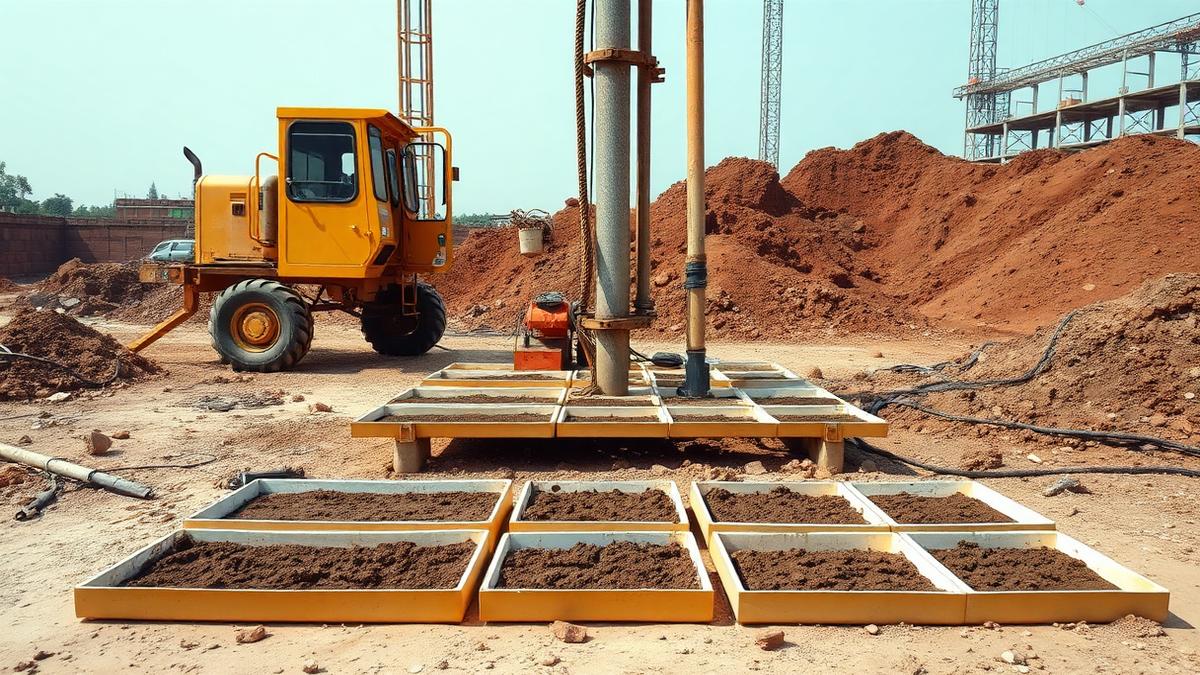
Chennai does not have one soil type. It has at least four, and they can change within a couple of kilometres. That is why a foundation detail that worked perfectly on a project in Ambattur can be entirely wrong for a plot in Sholinganallur. This guide maps the broad soil zones across the city and its suburbs, and explains which foundation approach each typically calls for.
A caution before the map: what follows is a general pattern drawn from decades of boring across the region. It tells you what to expect. It does not replace a site-specific soil investigation, and no responsible contractor should design a foundation without one.
Zone 1 — The coastal belt (ECR, Injambakkam to Mahabalipuram)
Loose to medium-dense marine sand with a high, saline water table. Bores collapse easily, and concrete needs protection from chloride and sulphate attack.
Typical solution: bored cast in-situ piles with full-length casing, or driven cast in-situ (DMC) piles; marine piling for waterfront structures; marine-grade concrete with increased cover.
Zone 2 — The eastern marsh and tank-bed corridor (OMR, Perungudi to Padur, Pallikaranai fringe, Velachery)
Filled ground over soft marine clay, with medium-dense sand appearing around ten to fifteen metres. Water table close to the surface. High settlement risk under shallow footings.
Typical solution: bored cast in-situ piling terminated in the dense sand; rotary hydraulic piling for large-diameter piles under towers; strict slurry and dewatering control.
Zone 3 — The central city (T Nagar, Adyar, Anna Nagar, Guindy, Kilpauk)
Medium-dense sand and stiff clay, generally better than the eastern belt, but plots are tight and surrounded by occupied buildings. Vibration and space are the governing constraints, not just bearing capacity.
Typical solution: low-vibration bored cast in-situ piling with compact rigs and carefully sequenced spoil removal.
Zone 4 — The western and north-western belt (Porur, Poonamallee, Ambattur, Avadi, Sriperumbudur, Kolapakkam)
Stiff clay, lateritic soil and weathered rock at moderate depth. Firmer overall, but the rock line can arrive early and unevenly.
Typical solution: rotary hydraulic piling where rock socketing is required; bored cast in-situ piling elsewhere; shorter pile lengths than the eastern belt for comparable loads.
Zone 5 — The southern suburbs (Tambaram, Guduvanchery, Maraimalai Nagar, Chengalpattu)
Expansive swell-shrink clay in large pockets, plus filled tank beds in newer layouts. Seasonal movement is the dominant failure mode.
Typical solution: under-reamed piles anchored below the active zone for houses and compound walls; bored cast in-situ piles through fill for heavier structures.
How to read your soil report against this map
When the geotechnical report arrives, look for four things before anything else:
- The strata log — where the weak layers end and competent strata begin.
- SPT N-values — the resistance profile with depth, which drives pile capacity.
- The water table — its depth decides casing, dewatering and concreting method.
- Chemical tests — chloride and sulphate content, which decide the concrete mix.
If those four are present and consistent with the zone your site sits in, the design conversation can start. If the report is a single shallow borehole with no SPT, ask for a proper investigation.
The practical takeaway
Foundation cost in Chennai is decided almost entirely by depth and diameter, and both are decided by soil. Every rupee spent on investigation buys certainty in a package that is many times larger. Skipping it does not save money; it moves the cost to a place where you cannot control it.
Need help interpreting your site?
Sri Saai Pile Foundation carries out soil investigation, pile design coordination, piling and load testing across Chennai and Tamil Nadu. Call +91 94449 71367 for a free site inspection, or email your soil report to saaipile@gmail.com and our engineers will tell you what it means for your foundation.