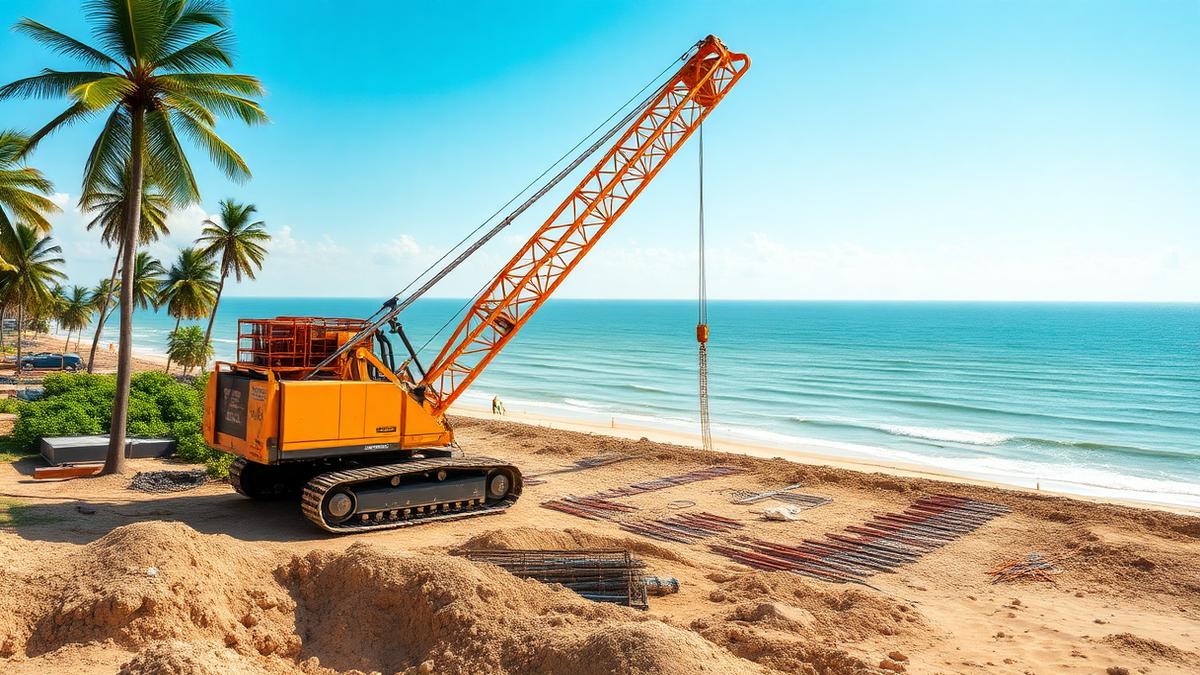
The East Coast Road belt — Injambakkam, Neelankarai, Uthandi, Muttukadu, Kovalam, Mahabalipuram — is one of the most sought-after stretches of land in Tamil Nadu, and one of the least forgiving to found a building on. Beach houses, resorts, villas and farmhouse projects here sit on loose coastal sand with saline groundwater close to the surface. Foundations that would be perfectly adequate two kilometres inland can fail here within a decade.
What makes coastal ground different
Three conditions define the ECR belt:
- Loose to medium-dense marine sand near the surface, with low lateral stability and a tendency to collapse into an open bore.
- A high, saline water table, often within one to two metres of ground level and rising further during the monsoon.
- Chloride and sulphate exposure, which attacks ordinary concrete and unprotected reinforcement over time.
Together these mean a coastal foundation is not just a deeper version of an inland one. It needs a different bore technique, a different concrete mix and a different level of quality control.
Method selection on the coast
For most ECR residential and hospitality projects we use bored cast in-situ piling with full-length temporary casing, which holds the loose sand open until the concrete is placed. Where the sand is very loose and the water table is high, driven cast in-situ (DMC) piling performs well because driving the casing compacts the surrounding soil rather than removing it.
For jetties, waterfront decks and structures partly in the water, marine piling with appropriate corrosion protection is the only correct answer. Under-reamed piles are useful on lighter coastal structures where uplift resistance matters — a genuine concern for single-storey structures with large roof areas exposed to sea wind.
Durability detailing that actually matters
Getting the pile down is only half the job on the coast. The details that decide whether the foundation lasts forty years or fifteen:
- Higher grade concrete with low permeability and a mix designed for a marine exposure class.
- Increased cover to reinforcement, in line with IS 456 requirements for severe and very severe exposure.
- Sulphate-resisting cement where the groundwater test shows elevated sulphate content.
- Continuous concreting through tremie so no cold joint sits in the splash or fluctuation zone.
We test the groundwater on coastal sites as part of the soil investigation rather than assuming a standard mix will do.
Access and setting out
Many ECR plots are narrow, sit behind compound walls or are reached through soft sand tracks. That drives equipment choice as much as soil does. Our tractor-mounted rigs get into plots that a crawler-mounted rotary rig cannot reach, which matters for individual villas and smaller resort blocks. On larger parcels with road frontage, we bring in the heavier rigs and finish faster.
Load testing on sand
Sand behaves differently from clay under sustained load, and settlement records from an initial load test are the only reliable proof that a design assumption holds. We carry out initial and routine load tests to IS 2911 on every coastal job, and issue the test curves with the pile log. If a contractor is willing to skip load testing on a coastal site, that alone tells you enough.
Planning a project on ECR?
Sri Saai Pile Foundation works throughout Injambakkam, Neelankarai, Uthandi, Muttukadu, Kovalam and Mahabalipuram, with our own rigs, crew and testing equipment. Call +91 94449 71367 for a free site inspection along ECR, or email saaipile@gmail.com with your plot details for an itemised quotation.